
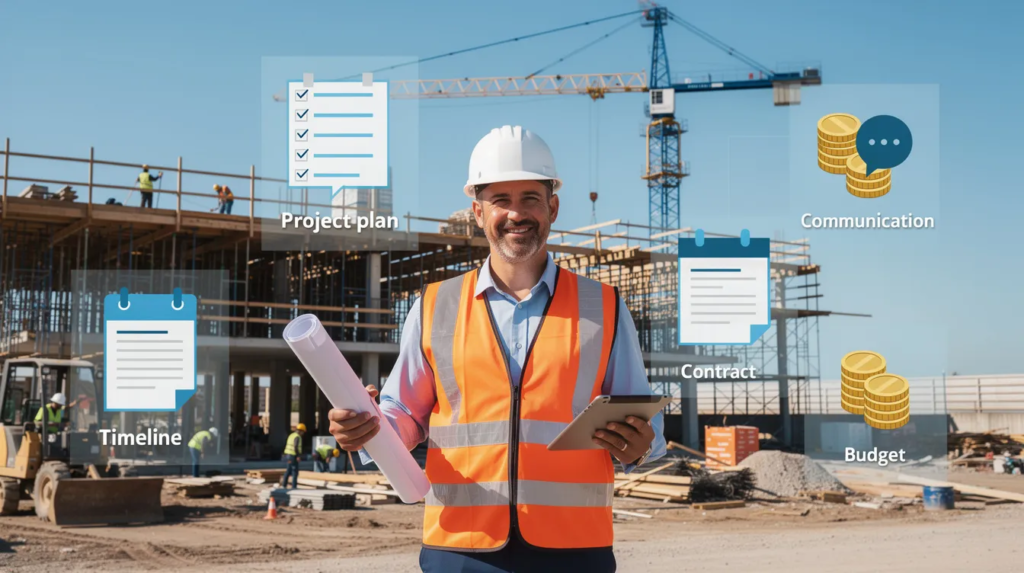
The term general contractor comes up the moment any serious construction project moves beyond the planning stage. Whether you’re renovating a kitchen or building a commercial office park, a general contractor is the person or company responsible for coordinating and delivering the entire project from start to finish—managing trades, subcontractors, budgets, schedules, and day-to-day execution to turn blueprints into reality. For property owners planning construction or renovations, clients hiring a GC, or anyone considering this career path, this guide explains what general contractors do, how they win and manage work, what licensing, insurance, contracts, and project delivery models look like, how they differ from construction managers, what they can earn, and how to choose the right partner for your next building project. Understanding that role up front can help you avoid costly delays, budget overruns, and compliance problems while keeping the work on schedule, on budget, and built to spec.
What Is a General Contractor?
A general contractor (GC) is the primary company or individual responsible for coordinating and delivering an entire construction project, from groundbreaking to final handover. General contractors oversee construction projects from start to finish, and they act as the main point of contact for clients, architects, engineers, suppliers, and subcontractors.
Here’s what distinguishes a GC from everyone else on a job site:
A general contractor works across all the trades involved in a project – concrete, framing, plumbing, electrical, finishes – rather than performing a single specialty.
GCs manage budgets, schedules, and subcontractors on-site, handling all the tasks that keep a building project moving forward.
They can be solo operators running small residential renovations or large firms overseeing multi-million-dollar commercial construction projects.
Trade subcontractors (electricians, plumbers, roofers) execute specific scopes; the GC manages scope, cost, and schedule across every one of them.
General contractors save time by managing complex projects so the property owner doesn’t have to coordinate dozens of moving parts independently.
The role shifts depending on the type of construction. A residential GC may swing a hammer alongside their crew, while a commercial GC focuses almost entirely on operations, logistics, and supervising subcontractors. Some general transferees delegate all tasks to subcontractors without performing any work themselves.
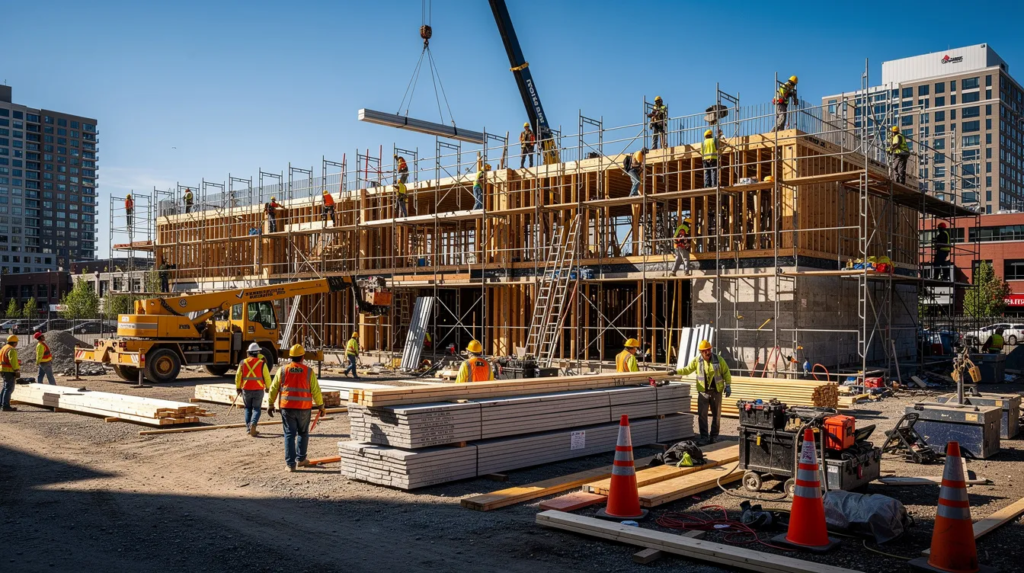
Core Responsibilities of a General Contractor
General contractors are financially and operationally responsible for the construction project. They’re contractually bound to deliver results in accordance with plans, specifications, schedule, and budget outlined in the general contractor agreement.
Key responsibilities include:
Bidding and estimating: General contractors provide estimates for project budgets and timelines before construction begins.
Contract compliance: Ensuring all the services promised in the contract are delivered, from materials to workmanship quality.
Hiring and supervising subcontractors: GCs hire subcontractors for each trade, then coordinate their work so activities flow in the correct sequence.
Scheduling and logistics: Project management includes coordinating the construction timeline, tracking progress, and scheduling deliveries so different aspects of the build don’t conflict.
Safety and code enforcement: They ensure compliance with building codes and safety regulations throughout the project lifecycle.
Financial management: Managing progress payments, change orders, and cost tracking to keep the project within budget.
Quality control: Inspecting construction work against architectural and engineering specifications, resolving defects, and verifying that different materials meet approved standards.
General contractors coordinate with multiple trades and oversee every aspect of the project. They have established relationships with reliable subcontractors, and clients benefit from reduced project costs through efficient management. General contractors ensure projects are completed on time and within budget – that’s the core promise.
How General Contractors Win Work: Bidding & Estimating
Before construction begins, a GC has to win the job. Here’s how that process typically works:
Solicitation: Project owners issue RFPs, RFQs, or invitations to bid with full plans, site information, and specifications. The GC reviews every detail.
Scope breakdown: The GC breaks the project into trade-specific scopes – concrete, framing, mechanical, electrical, plumbing, finishes – and solicits quotes from subcontractors and suppliers.
Pricing structure: The GC selects a contract type. A lump sum contract puts more risk on the contractor but gives the owner price certainty. Cost-plus arrangements share risk more transparently. Time-and-materials contracts suit projects with uncertain scope.
Loaded estimate: Beyond raw labor and materials, GCs include overhead, contingency, general liability insurance, and bonding requirements in their pricing. Missing any of these can destroy margins.
Technology: Modern GCs increasingly use estimating software and AI-augmented tools for take-offs and risk analysis. Adoption among top GCs has tripled over the past 18 months.
Bid comparisons should be detailed and based on the same project scope for accuracy. Comparing a lump sum bid against a cost-plus proposal for a different scope makes sense to no one.
Managing Construction Work on the Job Site
Once the contract is signed, the GC mobilizes. This is where planning meets reality.
Mobilization: Setting up temporary facilities, fencing, site access, staging areas, and security at the construction site.
Daily operations: Morning coordination meetings, sequencing subcontractor activities, checking that materials arrive on time, and adjusting schedules when weather or delays force changes.
Safety enforcement: Toolbox talks, PPE compliance, hazard identification, fall protection, and full compliance with OSHA regulations or local safety standards. A general contractor works as the person ultimately responsible for keeping workers safe.
Inspections and testing: Coordinating structural inspections, fire safety checks, concrete testing, and other code-required verifications so the building meets all approved design details.
Documentation: Daily reports, photographs, RFIs (requests for information), and meeting minutes. These records track every decision and protect both the owner and the GC if disputes arise.
The GC is the central hub of operations on every construction site. When something goes wrong – unexpected soil conditions, a supplier delay, a subcontractor no-show – the GC is the person who solves it.

Contracts, General Conditions & The General Contractor Agreement
The general contractor agreement is the legal backbone of the owner-GC relationship. A written contract should clearly detail the scope of work, payment schedule, and timeline.
Key elements every agreement must cover:
Scope of work: Exact inclusions, exclusions, allowances, and specifications.
General conditions: Ongoing project support costs like site management, temporary utilities, safety provisions, cleanup, and security. These differ from general requirements, which cover administrative obligations such as meeting formats, submittal processes, and QA/QC protocols.
Change order procedures: How changes in scope are initiated, approved, priced, and how they affect the schedule.
Liquidated damages: Penalties if the GC fails to complete by the agreed date.
Warranties: Duration and coverage for workmanship and materials.
Dispute resolution: Mediation, arbitration, or litigation – defined before problems arise.
Both sides should have construction-savvy legal counsel review the contract before signing. Vague scope definitions and missing clauses cause most construction disputes.
Licensing, Insurance & Compliance
Most US states require a local license to operate as a general contractor. As of 2026, roughly 29 states require statewide GC licensing, while others rely on local jurisdiction rules.
Here’s what you need to know:
General contractor license requirements typically include verified construction experience (usually 3–4 years), passing trade and business law exams, proof of financial stability, and a surety bond. A surety bond is required in most states for licensing.
California requires contractors to be licensed for projects over $500 – one of the strictest thresholds in the country. Some states, like Vermont and New Hampshire, do not require licenses and rely on local regulations instead.
General contractors often need to pass licensing exams covering trade knowledge, business law, and safety regulations.
Insurance: GCs commonly carry general liability insurance, workers’ compensation, and builder’s risk coverage. General contractors provide liability insurance for project protection, shielding owners from claims related to bodily injury or property damage.
Compliance: Beyond licensing, GCs must obtain necessary permits for construction and ensure compliance with building codes, zoning ordinances, environmental rules, and safety standards.
Homeowners can be held liable if unpermitted work is carried out on their property. It’s important to verify a contractor’s licensing and insurance to protect against liability before any construction work begins.
How to Become a General Contractor
The path from entry-level worker to licensed general contractor combines field experience, education, and business acumen.
Start in the trades: Many successful GCs begin as carpenters, masons, electricians, or site foremen, learning scheduling, crew management, and blueprint reading on active job sites.
Pursue education: An associate or bachelor’s degree in construction management, construction science, or civil engineering gives you an edge – especially for larger or public-sector projects.
Build business skills: Understanding contracts, project accounting, risk management, and labor planning is just as critical as knowing how building systems work in the field.
Get licensed: Satisfy your state’s experience requirement, pass required exams, obtain proof of bondability and insurance, and file for your general contractor license.
Earn certifications: Optional credentials like Certified Construction Manager (CCM), OSHA safety certifications, or LEED accreditation boost credibility with owners and engineers.
General Contractor Salary & Earning Potential
The general contractor salary question has two answers depending on whether you’re an employee or a business owner.
Employee compensation: The closest proxy is construction managers, who earn a median annual salary of roughly $114,990. The range spans from about $69,690 at the 10th percentile to $189,440+ at the top.
Business owner income: Profits depend on project volume, margins, cost control, and risk exposure. A small residential GC might earn modestly on a few projects per year, while a large commercial company can generate seven-figure profits.
Regional variation: Highest median salaries cluster in New York, Washington, Massachusetts, Alaska, and California. Lower cost-of-living states trend lower.
Growth outlook: The BLS projects construction manager employment to grow approximately 9% between 2024 and 2034, with about 46,800 annual openings expected.
Sustainable earning potential depends on a consistent pipeline of projects, strong subcontractor relationships, disciplined cost management, and a reputation for delivering a successful project on schedule.
Types of General Contractors & Project Delivery Models
Not every GC operates the same way, and in some regions, especially the UK and Australia, these professionals are commonly referred to as builders. The construction industry spans several categories and delivery models:
Residential general contractors focus on building and renovating homes – single-family, townhouses, and remodeling work with tighter budgets.
Commercial general contractors specialize in commercial construction projects like offices, schools, healthcare facilities, and industrial buildings.
Design-bid-build (traditional): The owner completes design, then bids the project to contractors. Clear scope, competitive pricing, separation between designer and builder.
Design-build contractors handle both design and construction phases under a single contract. This model reduces coordination gaps and can accelerate schedules, but the GC takes on greater responsibility for design details. One example is a commercial warehouse where speed and coordination matter.
CM-as-agent and CM-at-risk: These roles sometimes overlap with GC functions. A CM-at-risk may offer a guaranteed maximum price and hold subcontracts, functioning much like a full service provider.
Choosing the right type depends on project complexity, schedule urgency, owner experience, and willingness to absorb design changes during the process.
General Contractor vs. Construction Manager
These two roles overlap, but the differences matter – especially in how risk and cost are handled.
General Contractor | Construction Manager | |
|---|---|---|
Timing | Typically engaged after design is complete | Often brought on during the design phase |
Contract | Holds prime contract; hires all subcontractors | Paid a fee; may or may not hold trade contracts |
Risk | Bears cost, schedule, and safety risk | Lower risk in advisory model; higher in CM-at-risk |
Payment | Fixed or negotiated contract price | Fee-based (percentage, hourly, or fixed) |
Owner relationship | Single point of accountability | Collaborative, advisory |
A project manager on a smaller, straightforward build often makes sense as a GC. Complex, fast-track, or highly specialized projects may benefit from early construction manager involvement. Both construction managers and GCs play a major role in delivering quality results – the contract determines who holds what responsibility.
Tips for Hiring and Working With a General Contractor
The hiring process for a general contractor involves defining the project scope and interviewing candidates. Here’s a practical checklist:
Verify credentials: Confirm the GC holds a valid general contractor license, carries general liability insurance and workers’ compensation, and meets bonding requirements. Ask for proof.
Check references: References should be checked to evaluate a general contractor’s reliability and experience. Visit at least one active site to see how the GC runs operations, enforces safety, and interacts with the trades involved.
Get a detailed contract: Insist on a written general contractor agreement covering scope, schedule milestones, payment terms, change order procedures, and dispute resolution. Substantial upfront payments should be avoided in favor of a structured milestone payment plan.
Prioritize communication: Communication and responsiveness are critical factors when selecting a general contractor. Weekly meetings, written updates, and fast decisions on selections keep the large project on track.
Set clear expectations: Define finishes, tolerances, budget priorities, and quality standards before construction begins. Hiring a general contractor ensures compliance with building codes, but clear expectations at the outset help the GC deliver results that match your vision.
The right partner isn't always the cheapest bid. Look for a licensed builder who communicates well, documents everything, and treats your property like their reputation depends on it - because it does.

Whether you’re a property owner planning a renovation or someone considering a career in the construction industry, understanding the general contractor’s role is the foundation of every successful project. Start by defining your scope, interview at least three licensed contractors, and insist on a detailed written contract before a single shovel hits the ground.